← All articles · Where Bearings Work
Wind Turbine Bearings: The Five Places They Work
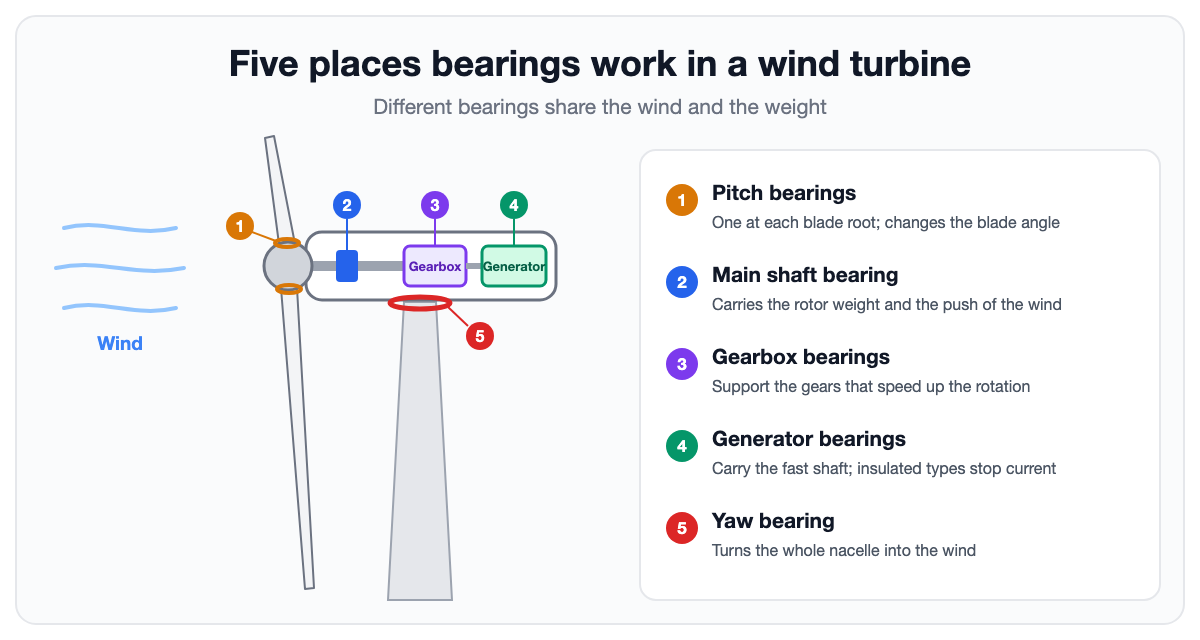
A wind turbine uses bearings in five different places, each with its own job. Pitch bearings turn the blades, the main shaft bearing carries the blades and hub, gearbox bearings support the gears that speed up the rotation, generator bearings carry the fast-running shaft, and the yaw bearing turns the whole nacelle into the wind. The rotor turns slowly, but the wind never stops changing, which makes this one of the toughest jobs a bearing can have.
Not a pinwheel, a rotating machine
From a distance a wind turbine looks like a giant pinwheel. But on today's large turbines a single blade can be longer than 100 m, and some turbines stand close to 200 m tall. Inside the nacelle at the top sit shafts, gears and a generator, far larger and more precise than anything in a car.
The blades turn slowly, but not gently. Wind speed and direction change within seconds, and even during one revolution a blade meets different wind high up and low down. So the bearings inside see loads that keep changing in size and direction.
The main shaft bearing holds the rotor
The blades and hub weigh tens of tons or more. The main shaft bearing carries that weight and keeps it turning, while also taking the push of the wind on the blades. Spherical roller bearings or large tapered roller bearings are commonly used. A spherical roller bearing aligns itself when the shaft bends slightly in the wind, which makes it a good fit for this job.
From slow to fast: gearbox and generator
The blades turn slowly, but the generator has to spin much faster to make electricity efficiently. The gearbox between them raises the speed by tens of times, using several gear stages and many roller and ball bearings. Gearboxes are known as one of the most maintenance-heavy parts of a wind turbine, and their failures often start in the bearings. That is one reason some turbines now skip the gearbox and drive a large generator directly.
The generator shaft runs on bearings such as deep groove ball bearings. In generators, small electric currents can pass through the bearings and damage the raceways, so insulated bearings that block the current are used more and more. The same problem appears in factory motors driven by inverters.
Yaw and pitch: turning into the wind, changing the blade angle
The wind does not always blow from the same side. When it shifts, the whole nacelle slowly turns so that the blades face the wind. The yaw bearing between the nacelle and the tower carries this rotation.
Each blade has its own pitch bearing at its root, so three blades mean three pitch bearings. They change the blade angle to catch more wind when it is light and to spill wind when it is too strong, protecting the turbine.
Both are usually slewing bearings several meters in diameter. Gear teeth are often cut directly into one ring; a motor drives a small pinion, and the large ring turns with it. One bearing both carries the load and transmits the rotation. Four-point contact ball designs, in which each ball can touch the raceways at four points, are widely used.
Offshore is harder
Offshore turbines face salty wind, humidity and waves all the time. When something breaks, repairs need vessels and large cranes, so they cost far more time and money. Offshore bearings are therefore built to resist corrosion and to last, and remote monitoring of lubrication and vibration is spreading fast. How far you can trust the bearings decides how much the turbine earns.
Related articles
- The History of Bearings: From Rolling Logs to Ball Bearings
- How to Read Bearing Numbers (6205ZZ Explained)
- Inside Robot Joints: Crossed Roller Bearings (coming soon)
- Why Motor Bearings Fail: Inverters and Electrical Erosion (coming soon)
Looking for bearings for your equipment?
Send us the bearing number, a photo, or where it is used, and we will help you find the right bearing and its equivalents.
Looking for this bearing? Just send us the number or a photo.
Request a Quote