← All articles · Bearing History
The History of Bearings: From Rolling Logs to Ball Bearings
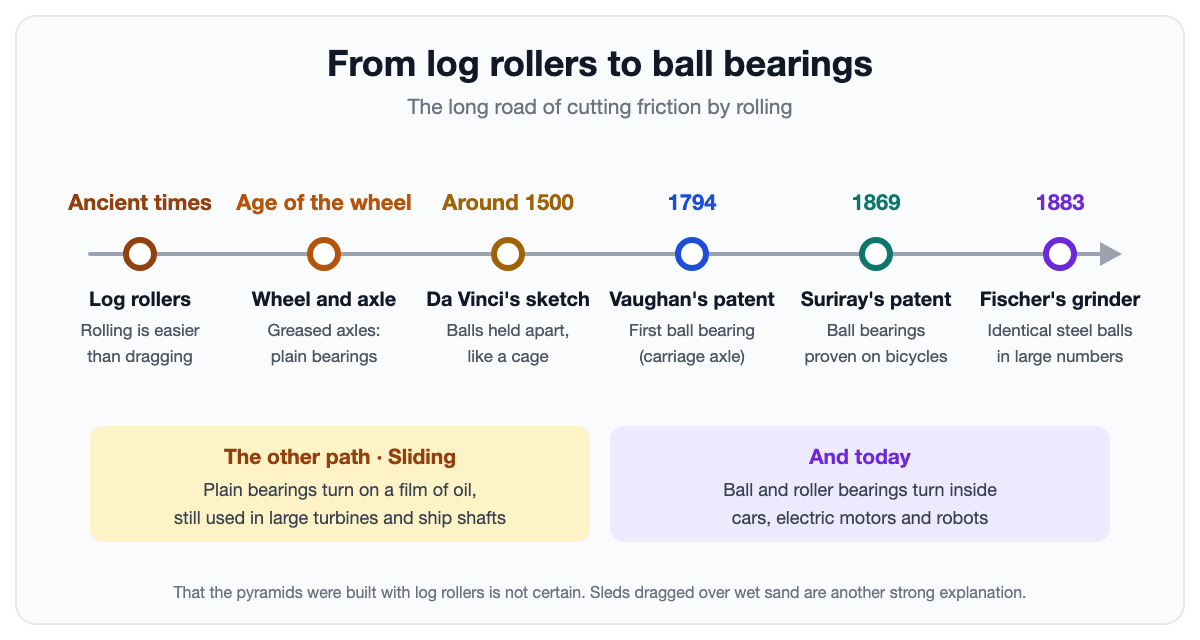
No one person invented the bearing. It began with the ancient know-how of rolling heavy loads instead of dragging them, and went on to plain bearings, the greased axles of wheels. Then came the first ball bearing patent in 1794, the bicycle in 1869 and the mass production of identical steel balls in 1883, which together made the bearing we know today.
Rolling instead of dragging: an ancient idea
Drag a heavy stone along the ground, and the whole surface touching the ground resists the motion. That resistance is friction. Put the stone on round logs instead, and the point of contact keeps changing, so it moves with far less effort. Turning sliding into rolling is still the principle behind today's ball and roller bearings.
The story that the pyramids were built by rolling stones on logs is famous, but it is not certain. A wall painting in the tomb of Djehutihotep in Egypt shows a huge statue on a sled, with a worker pouring water on the ground in front of it. In 2014, researchers at the University of Amsterdam showed that wetting the sand just enough cuts the number of people needed to pull such a sled by about half. Rolling on logs or dragging over wet sand, the goal was the same: cut the friction and move what human strength alone could not.
Boats were launched in two ways as well: rolled over logs laid under the hull, or slid over supports coated with oil or animal fat. One path cuts friction by rolling, the other by sliding on grease or oil. Bearings grew along both.
The wheel's new problem: the axle
The wheel did away with the work of carrying logs back to the front again and again. But a wheel needs an axle at its center, and the axle and the hole in the wheel rubbed against each other and wore away. People used harder woods, fitted bronze linings into the hole, and applied animal fat or vegetable oil. This part that surrounds and supports the axle is the oldest kind of bearing, and the beginning of the plain bearing.
Plain bearings are not old technology. As the shaft turns, it drags oil into the gap and builds a thin oil film, and the shaft turns floating on it. Because they handle heavy loads and shocks well, they are still used in huge machines such as ship propeller shafts and power plant turbines.
Steel balls inside the machine: from Leonardo da Vinci to Philip Vaughan
The idea of building rolling into a machine appeared in the Renaissance. In sketches from around 1500, Leonardo da Vinci placed balls between two surfaces and even designed a way to keep the balls apart so they would not rub against one another. It looks much like the cage of a modern ball bearing, the part that keeps the balls evenly spaced. But no one could yet make metal balls that were all exactly the same size.
The 18th century saw an attempt on a completely different scale. In 1769–1770, Russia moved the "Thunder Stone" to St. Petersburg to serve as the pedestal of the Bronze Horseman, the statue of Peter the Great. The rock, weighing more than 1,500 tons, was loaded onto a sled resting on bronze balls and moved along a grooved track.
In 1794, Philip Vaughan, an ironmaster in Wales, patented a design that put iron balls between a carriage axle and the wheel hub. It is often called the world's first ball bearing patent. The idea was right, but it came too early. Balls made by hand were all slightly different in size, so the load fell on a few of the largest balls and the bearing soon wore out.
Proven by the bicycle, perfected by Fischer
It was the bicycle that made ball bearings known to the world. A bicycle runs on leg power, so even a little friction is felt at once. In August 1869, Jules Suriray, a bicycle mechanic in Paris, patented a ball bearing for bicycles. James Moore, who won the long-distance race from Paris to Rouen that November, is said to have ridden a bicycle fitted with these bearings. Riders did not need to know the principle to feel the difference: the bicycle ran more easily, and the wheels kept spinning long after the pedaling stopped.
The task that remained was making many identical balls. In 1883, Friedrich Fischer of Schweinfurt, Germany, came up with a way to grind steel balls of even size and roundness by machine, in large numbers. From then on, the ball bearing was no longer a special part that depended on a craftsman's hands, but an industrial product made in factories. Fischer's company became the root of FAG, today a German bearing brand of the Schaeffler Group, and Schweinfurt is still a center of the bearing industry.
And today
The rolling path that started with logs became ball and roller bearings, which turn inside cars, electric motors and robots. The sliding path that started with grease became plain bearings, which turn on a film of oil and carry the shafts of turbines and ships. The shapes and materials have changed, but the job has been the same for thousands of years: reduce friction, carry the weight, and keep the motion you want going for a long time.
Related articles
- How to Read Bearing Numbers (6205ZZ Explained)
- Ball Bearings vs Roller Bearings: What Is the Difference? (coming soon)
- Wind Turbine Bearings: The Five Places They Work
Looking for a bearing for an old machine?
Even when the number has worn off or the bearing is discontinued, we can help you find an equivalent of the same size.
Looking for this bearing? Just send us the number or a photo.
Request a Quote